
When you buy a surge protector, you probably look at the number of outlets, the price, and maybe the brand. But there’s one number that matters more than most people realize: the joule rating. This simple number can decide whether your electronics survive a power surge or get damaged forever. But how many joules do you actually need in a surge protector? If you want to protect your devices and not waste money, understanding this is key.
Many people think all surge protectors are the same, or that the highest joule number is always best. The truth is more interesting, and knowing the details can save you from both overspending and disaster. Let’s break down exactly what joules mean, what your devices need, and how to choose the right protection for your home or office.
What Is A Surge Protector Joule Rating?
The joule rating on a surge protector shows how much energy it can absorb from power surges. Think of joules as a shield’s strength—the higher the joule number, the more hits it can take before failing. Each time a surge happens (for example, from lightning or a power grid issue), the surge protector absorbs the extra energy. Over time, this shield gets weaker until it cannot protect your devices anymore.
For example, if a surge protector is rated for 1,000 joules, it can absorb one big 1,000-joule surge or several smaller surges that add up to 1,000 joules. After that, the protector stops working (sometimes without warning).
Why Do Power Surges Happen?
Power surges can come from many sources:
- Lightning strikes (can cause very large surges)
- Power outages (when power returns, it can spike)
- Large appliances turning on/off (like air conditioners or refrigerators)
- Faulty wiring or electrical problems
Even small surges can slowly damage sensitive devices like computers, TVs, or gaming consoles. That’s why a surge protector with a good joule rating is important for every modern home.

Credit: www.eaton.com
How Many Joules Do You Need For Different Devices?
The answer depends on what you’re protecting and how valuable or sensitive it is. Not all electronics need the same level of protection. Here’s a simple guide:
1. Basic Electronics (lamps, Alarm Clocks, Phone Chargers)
- Recommended joules: 200 to 400 joules
- These devices are not very sensitive. Small surges won’t damage them easily. A low-joule surge protector is fine.
2. Office Equipment (printers, Scanners, Basic Routers)
- Recommended joules: 400 to 1000 joules
- These devices have some electronics but are not as sensitive as computers. A mid-level joule rating gives good protection.
3. Home Entertainment (tvs, Sound Systems, Game Consoles)
- Recommended joules: 1000 to 2000 joules
- Modern TVs and consoles have sensitive circuits. A higher joule rating is necessary to avoid damage.
4. Computers And Laptops
- Recommended joules: 1500 to 2500 joules
- Computers can lose data or get damaged by small surges. A strong surge protector is a must. For expensive gaming PCs or workstations, go higher within this range.
5. Home Appliances (refrigerators, Washers, Microwaves)
- Recommended joules: 1000 to 2000 joules
- Large appliances are often hit by surges when turning on/off. They need higher protection, especially if you live in an area with unstable electricity.
6. Home Office Or Professional Equipment
- Recommended joules: 2000+ joules
- If you use expensive equipment for work (servers, medical devices, high-end audio), always choose surge protectors with the highest available joule ratings.
Quick Comparison Table
Below is a table comparing different devices and their recommended joule ratings:
| Device Type | Recommended Joules | Risk Level |
|---|---|---|
| Lamp/Alarm Clock | 200–400 | Low |
| Printer/Router | 400–1000 | Medium |
| TV/Game Console | 1000–2000 | High |
| Computer/Laptop | 1500–2500 | Very High |
| Home Office Equipment | 2000+ | Critical |
How To Calculate Your Joule Needs
If you want to be exact, add up the value and sensitivity of the devices you plan to connect. Here’s how:
- List your devices: Write down each device you want to protect.
- Check the value: How expensive or hard to replace is each one?
- Check sensitivity: Is it easily damaged by electrical problems (computers, TVs)?
- Add a safety margin: Always round up to the next highest joule rating for peace of mind.
Example: If you want to protect a laptop ($1,000), a monitor ($300), and a printer ($100), you should look for a surge protector with at least 1,500 joules—2,000 is better.
Is More Joules Always Better?
Many people think the highest joule rating is always best. While more joules means more protection, there are practical limits:
- Price: Higher joule protectors cost more.
- Size: Large protectors can be bulky.
- Lifespan: Higher joule units last longer, but not forever.
For most homes, a surge protector with 1,000 to 2,000 joules is enough. Only choose a higher rating if you have expensive or very sensitive equipment.
Surge Protector Lifespan: When To Replace
Surge protectors don’t last forever. Every time they absorb a surge, their joule capacity drops. Some have a warning light that goes out when protection is gone, but many don’t.
Here are key points:
- Average lifespan: 2 to 5 years, depending on local power quality and number of surges.
- Frequent surges: If you live in an area with storms or old wiring, replace protectors more often.
- No indicator light: If your protector is more than 3 years old, it’s safer to replace it.
Pro tip: Mark the purchase date on your surge protector. Set a reminder to check or replace it after 2–3 years.
Credit: www.cyberpowersystems.com
Types Of Surge Protectors And Their Joule Ratings
Not all surge protectors are the same. The type you choose also affects how many joules you get.
Basic Power Strips
- Often have no surge protection at all, or very low (100–400 joules).
- Good for simple devices like lamps or fans.
Surge Protector Strips
- Common in homes and offices.
- Offer a range from 400 up to 4,000 joules.
- Best for TVs, computers, and home electronics.
Whole-house Surge Protectors
- Installed at your main electrical panel.
- Can absorb tens of thousands of joules (20,000+).
- Protect every device in the home but cost much more.
Wall-mount Surge Protectors
- Plug directly into the wall.
- Usually lower joule ratings (400–1,000).
- Useful for small spaces or travel.
Here’s a quick comparison of different surge protector types and their typical joule ranges:
| Type | Typical Joule Range | Best Use |
|---|---|---|
| Basic Power Strip | 100–400 | Lamps, chargers |
| Surge Protector Strip | 400–4000 | TVs, PCs, consoles |
| Wall-Mount Protector | 400–1000 | Small appliances |
| Whole-House Protector | 20,000+ | Entire home |
Two Key Insights Most People Miss
1. Joules Are Not The Only Factor
Many shoppers focus only on joule rating. But the clamping voltage (how much voltage triggers the surge protector) and response time (how fast it reacts) are also important. A lower clamping voltage (like 330V) means better protection for sensitive devices. Always check these specs, not just joules.
2. Surge Protectors Don’t Last After A Big Surge
A single major lightning strike can use up the entire joule capacity at once. After a big event, even the highest-rated protector may be “dead” inside, even if it looks normal. Always replace surge protectors after a major surge.
Common Mistakes When Choosing A Surge Protector
- Choosing too low a joule rating for valuable electronics.
- Not replacing old protectors (many people use them for 10+ years).
- Using power strips thinking they are surge protectors—not all strips have surge protection.
- Overloading one protector with too many devices.
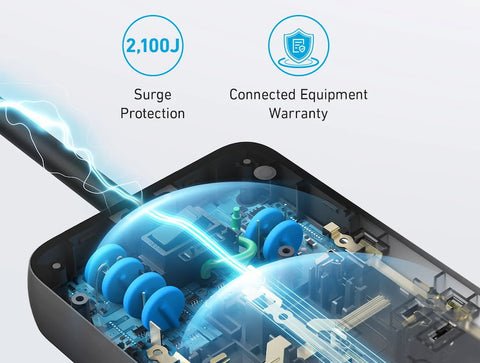
- Ignoring warranty terms—some offer equipment coverage, but only if you follow rules.
Tips To Get The Best Surge Protection
- Buy from trusted brands: Quality matters more than just joule rating.
- Look for indicator lights: They show if protection is still working.
- Check for UL or ETL certification: These mean the product meets safety standards.
- Consider whole-house protection if you own your home and have many electronics.
- Don’t daisy-chain (connect multiple protectors together)—this is unsafe.
Credit: www.anker.com
Real-life Example: Home Office Setup
Imagine you have a small home office with a computer, monitor, printer, and modem. Together, they’re worth about $2,000. You live in a city with occasional storms. Here, a surge protector with at least 2,000 joules is smart. If you have important work data, also consider a battery backup (UPS) with surge protection.
How Surge Protectors Compare To Other Safety Devices
Some people confuse surge protectors with circuit breakers or GFCI outlets. Here’s a quick comparison:
| Device | Main Function | Protects Against |
|---|---|---|
| Surge Protector | Absorbs excess voltage | Power surges, spikes |
| Circuit Breaker | Cuts power during overload | Overcurrent, short circuits |
| GFCI Outlet | Cuts power during ground faults | Electric shocks, ground faults |
Each device serves a unique purpose. For full safety, use surge protectors along with proper breakers and GFCI outlets.
Frequently Asked Questions
How Do I Know When To Replace My Surge Protector?
Most surge protectors don’t show when they stop working. If it has an indicator light, replace it if the light goes out. Otherwise, replace it every 2–3 years or after a major power surge.
Can I Plug A Surge Protector Into Another Surge Protector?
No, this is called daisy-chaining and is unsafe. It can cause overheating, fire, or loss of protection. Always plug surge protectors directly into the wall outlet.
Will A Higher Joule Rating Slow Down My Devices?
No, the joule rating only affects how much surge energy it can absorb. It does not slow down or affect the performance of your devices.
Do Surge Protectors Work Against Lightning?
Surge protectors can help against small lightning surges, but a direct strike can overwhelm even high-joule protectors. For full protection, use a whole-house surge protector and unplug devices during storms.
Are Expensive Surge Protectors Worth It?
Often, more expensive surge protectors offer higher joule ratings, better build quality, and longer warranties. For valuable electronics, the extra cost is usually worth it for better protection. For more details, check this Consumer Reports guide.
Choosing the right surge protector is about more than just picking the biggest number on the box. With the right joule rating, your electronics stay safer, and you avoid unnecessary expenses. Remember to check your protector’s age, understand what you’re plugging in, and never ignore the small print.
Protect your devices wisely—your future self will thank you.
Related Office Guides
Continue with these related workspace guides: