
Most people plug their computers, TVs, or phone chargers into a power strip and never think twice. But if you want to protect your valuable devices from sudden electrical surges, you need more than just extra outlets—you need a surge protector. And if you’ve shopped for one, you’ve probably noticed a number on the box: the joules rating. What does it really mean? Is a higher number always better? How many joules do you need to stay safe?
Let’s explore the real meaning behind surge protector joules ratings, why they matter, how to choose wisely, and what mistakes to avoid. By the end, you’ll know how to keep your devices safe—and avoid wasting money or risking damage.
What Is A Surge Protector Joules Rating?
A joule is a unit of energy. In surge protectors, the joules rating tells you how much energy the device can absorb from a power surge before it fails. Think of it as a shield: each surge hits the shield, and the shield can take only so many hits before it breaks.
For example, if a surge protector has a 1,000 joules rating, it means it can absorb up to 1,000 joules of energy before it stops protecting.
Why Does This Matter?
Power surges happen often. A big lightning strike is rare, but small surges happen every day. Each surge uses up some of the joule capacity. When the total joules are gone, your surge protector is just a normal power strip.
If you care about your computer, TV, gaming console, or smart fridge, you want a surge protector that can survive more surges, especially bigger ones.
How Power Surges Work
To understand joules ratings, you need to know what a power surge is. A power surge is a sudden increase in voltage that travels through your electrical wiring. It can be caused by:
- Lightning strikes near your home
- Power outages or grid switching by the electric company
- Large appliances turning on or off (like air conditioners, refrigerators)
- Faulty wiring or electrical faults in your building
These surges can be tiny (maybe you won’t notice), or huge (enough to fry electronics).
What Happens During A Surge?
When a surge comes through, it can:
- Burn out sensitive circuits
- Shorten the lifespan of devices
- Cause data loss or crashes
- Completely destroy equipment in extreme cases
Surge protectors absorb or block the extra energy. The joules rating tells you how much energy the protector can handle before it is “used up. ”

Credit: switchedhome.com
How Joules Are Used Up
Every time your surge protector absorbs a surge, it uses some of its joule capacity. Over time, even small surges can add up. Think of it like an umbrella in a rainstorm: each drop (or splash) wears it out a bit.
Example
If your surge protector has 1,500 joules, and it absorbs three surges of 500 joules, it is “done. ” After that, it can’t protect your devices from any more surges. Sometimes, the surge protector will stop working, but often it will keep powering your devices—with no protection left.
Most surge protectors don’t warn you when their joule capacity is gone. This is a common mistake: people think they’re still safe but are not.
How Much Joule Rating Do You Need?
Not all devices need the same protection. Here’s a simple way to decide:
| Device Type | Minimum Joule Rating | Example Devices |
|---|---|---|
| Basic Electronics | 200–400 joules | Lamps, phone chargers |
| Home Office | 600–1,000 joules | PCs, printers, WiFi routers |
| Home Theater/AV | 1,000–2,000 joules | TVs, gaming consoles, sound systems |
| High-End/Professional | 2,000+ joules | Servers, studio equipment, expensive PCs |
Non-obvious insight: Many people think higher joules always mean better protection, but it’s about matching protection to device value and risk. For example, you don’t need a 3,000-joule surge protector for a $10 desk lamp.
Special Situations
- Storm-prone areas: If you live in a place with frequent lightning or unreliable power, choose a higher joule rating (2,000+).
- Multiple devices: If you plug several expensive devices into one protector, use a higher joule rating.
- Old wiring: Older homes may have more frequent surges. Higher joule ratings are wise.
Are More Joules Always Better?
A higher joule rating means a surge protector can absorb more energy over its life. But more is not always better for every situation.
Pros Of Higher Joules
- Longer protection life (can handle more surges)
- Better for expensive or sensitive electronics
- More peace of mind
Cons
- Usually more expensive
- Bulkier in size
- Not necessary for low-value items
Non-obvious insight: The *way* joules are delivered matters too. A cheap surge protector with a high joule rating may not respond as fast as a quality one with fewer joules. The clamping voltage (how much surge gets through before the protector acts) and response time are also important.
Surge Protector Joules Vs. Other Specs
Joules are not the only factor in surge protection. Here are a few more things to check:
| Specification | What It Means | Why It Matters |
|---|---|---|
| Clamping Voltage | Voltage at which the protector “turns on” | Lower is better (330V is good) |
| Response Time | How fast it reacts to a surge | Shorter is better (<1 nanosecond is best) |
| Number of Outlets | How many devices you can plug in | Convenience, but not about protection |
| Indicator Lights | Show if protection is still working | Helps know when to replace |
| UL 1449 Rating | Independent safety test for surge protectors | Look for this for trusted protection |
Clamping Voltage
This is the voltage at which the surge protector starts to work. For North America, 330V is considered good, 400V is average, and 500V is weaker protection.
Response Time
The faster the surge protector reacts, the better. Some surges can happen in microseconds. Look for a response time under 1 nanosecond.
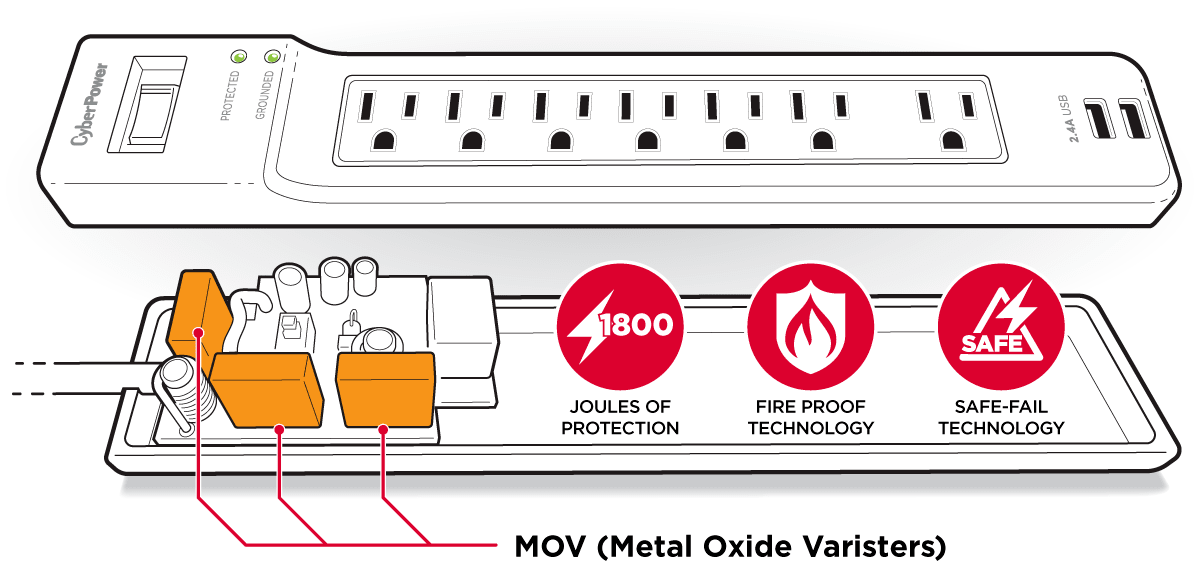
Indicator Lights
Many surge protectors have a light that tells you if protection is still active. If the light goes out, replace the protector—even if it still powers your devices.
Credit: www.cyberpowersystems.com
How Surge Protectors Actually Work
A surge protector is not just a “magic box.” Inside, the most common part is a Metal Oxide Varistor (MOV). This component absorbs excess voltage and releases it as heat.
When a surge happens, the MOV takes the hit. Over time, it wears down. Once it is used up, the surge protector stops protecting. Some high-end protectors use gas discharge tubes or other advanced parts, but MOVs are the standard.
Practical tip: If you hear a pop or smell burning from your surge protector after a big storm, unplug it and replace it. The MOV may be burned out.
How To Choose The Right Joule Rating For Each Device
Let’s look at some common situations:
For Computers And Laptops
These devices are sensitive to power problems and often hold important data. A surge can destroy the motherboard or power supply.
- Minimum: 1,000 joules
- Better: 2,000+ joules if you use your computer for work, gaming, or have expensive parts
For Tvs And Home Theater
Modern TVs and sound systems are pricey and can be wrecked by a single surge.
- Minimum: 1,000 joules
- Better: 1,500–2,500 joules for high-end setups
For Kitchen Appliances
Most kitchen appliances (microwaves, coffee makers) are less sensitive but still can be damaged.
- Minimum: 400–800 joules
- Tip: Don’t plug refrigerators or freezers into surge protectors unless the manufacturer says it’s okay
For Phone Chargers And Small Gadgets
Cheap chargers and small electronics don’t need high protection.
- Minimum: 200–400 joules
For Gaming Consoles
Consoles are sensitive and expensive to replace.
- Minimum: 1,000 joules
- Better: 1,500+ joules
For Office Equipment (printers, Modems, Routers)
These can be sensitive, and losing them can disrupt your work.
- Minimum: 600–1,000 joules
Do Surge Protectors Wear Out?
Yes, surge protectors wear out. Each surge takes away some of the joule rating. After enough surges, the device will no longer protect your electronics.
How Long Do They Last?
There is no exact answer. It depends on:
- How many surges hit it
- How big each surge is
- The initial joule rating
Some people get 3–5 years of protection; others need to replace after just one big surge.
Common mistake: Keeping a surge protector for 10 years without replacing it. It may have zero protection left!
How To Know When To Replace
- If the “protected” light goes out
- After a lightning storm or power outage
- Every 3–5 years, even if it looks fine
Common Mistakes When Choosing Surge Protector Joules
- Ignoring the joule rating: Many buyers look only at the number of outlets or USB ports, not protection.
- Assuming all surge protectors are the same: Cheap power strips may have zero surge protection or just 100–200 joules—almost useless for expensive gear.
- Not matching joules to device value: Don’t use a 200-joule protector for a $2,000 gaming PC.
- Never replacing the protector: As explained, joules get used up. Old protectors can be “dead inside.”
- Not looking for UL 1449 rating: Some products are not tested for safety and may not work as claimed.
- Using the wrong surge protector for high-power appliances: Some protectors are not rated for microwaves or air conditioners.
- Overloading with too many devices: Even with a high joule rating, plugging in too many devices can lead to overheating or fire risk.
Real-world Example: How Joules Are Used
Imagine you buy a surge protector with 2,000 joules. Over two years, your home experiences:
- 20 small surges (20 joules each) = 400 joules
- 1 medium surge (400 joules) = 400 joules
- 1 big surge (1,200 joules) = 1,200 joules
Total used: 2,000 joules. After that, the protector cannot absorb any more surges. If you keep using it, your devices are at risk.
Comparing Popular Surge Protector Joule Ratings
Here is a quick comparison of popular surge protectors and their joule ratings:
| Brand/Model | Joule Rating | Best For |
|---|---|---|
| Belkin 12-Outlet | 3,940 joules | Home theater, high-end PCs |
| APC P11U2 | 2,880 joules | Office, multiple devices |
| Amazon Basics 6-Outlet | 790 joules | Small electronics, chargers |
| Tripp Lite TLP1008TEL | 2,395 joules | Computers, home office |
| Philips 6-Outlet | 900 joules | Basic electronics |
Notice how the joule rating changes by product and price. Higher ratings are best for valuable electronics.
Myths About Surge Protector Joules
Let’s clear up a few common myths:
- Myth: A surge protector with any joule rating will last forever.
Fact: Joules run out over time.
- Myth: More joules always means better surge protection.
Fact: Quality of components and clamping voltage also matter.
- Myth: Power strips and surge protectors are the same.
Fact: Many power strips have no surge protection at all.
- Myth: You only need surge protection during storms.
Fact: Small surges happen daily from normal power use.
- Myth: Surge protectors will protect against direct lightning strikes.
Fact: No consumer surge protector can stop a direct hit. They only help with indirect or smaller surges.
How To Get The Most Out Of Your Surge Protector
- Buy the right joule rating for your devices.
- Check for indicator lights regularly to make sure protection is active.
- Don’t overload the protector with too many devices.
- Replace every 3–5 years, or after big power events.
- Register your surge protector if it has a connected equipment warranty.
- Plug it directly into the wall, not into another surge protector (no daisy-chaining).
Pro tip: For the best protection, combine a surge protector with an uninterruptible power supply (UPS) for computers and servers. The UPS handles both surges and power loss.
Surge Protector Warranty And Joules
Many surge protectors offer a warranty that covers connected equipment. But read the fine print:
- The warranty only applies if the surge protector was working (joules not used up).
- You may need to register the product.
- Some warranties are only for a few years.
If protection fails and your device is damaged, you’ll need proof of purchase, and sometimes the surge protector itself, for a claim.
When Not To Use A Surge Protector
Surge protectors are not for every device:
- Refrigerators, freezers, and air conditioners: Many manufacturers recommend plugging these directly into the wall to avoid tripping the compressor or damaging the appliance.
- Heavy-duty tools: These may need special surge protection, not a standard home model.
- Outside or wet areas: Only use surge protectors rated for outdoor use.

Credit: www.amazon.com
Environmental Impact: What Happens To Old Surge Protectors?
When a surge protector reaches the end of its joule life, don’t just throw it in the trash. Many contain metals and plastics that should be recycled. Some electronics stores have recycling programs. Ask your local waste service for advice.
Pro tip: Mark your surge protector with the date you bought it. This makes it easier to remember when to replace.
Final Thoughts
Understanding surge protector joule ratings is key to protecting your electronics and your wallet. Joules measure how much energy your protector can absorb before it fails. Higher is better for expensive or sensitive devices, but it’s not the only thing to look for—quality, clamping voltage, response time, and UL 1449 rating matter too.
Don’t make the common mistake of keeping an old surge protector for years without checking or replacing it. Spend a few extra dollars for the right protection for your home or office. And always recycle your old protectors responsibly.
If you want more details on surge protection and electrical safety, check out this Wikipedia page on surge protectors.
Frequently Asked Questions
What Does The Joule Rating Mean On A Surge Protector?
The joule rating shows how much energy a surge protector can absorb before it stops protecting. Higher numbers mean more protection and longer life. Once the joules are used up, the device no longer keeps your electronics safe.
How Many Joules Do I Need For My Computer?
For a basic computer, at least 1,000 joules is recommended. For gaming or professional computers, 2,000 joules or more is better. This protects against both small and large surges.
Does A Higher Joule Rating Mean Better Protection?
A higher joule rating means the protector can absorb more energy. But clamping voltage and response time are also important. For best results, choose a protector with a high joule rating, low clamping voltage, and a fast response.
How Often Should I Replace My Surge Protector?
Replace your surge protector every 3–5 years, after a major power event, or when the indicator light goes out. Surge protectors wear out as they absorb surges, even if they still power your devices.
Can I Plug A Surge Protector Into Another Surge Protector?
No, you should not “daisy chain” surge protectors. This can cause overheating and fire risks. Always plug surge protectors directly into a wall outlet.